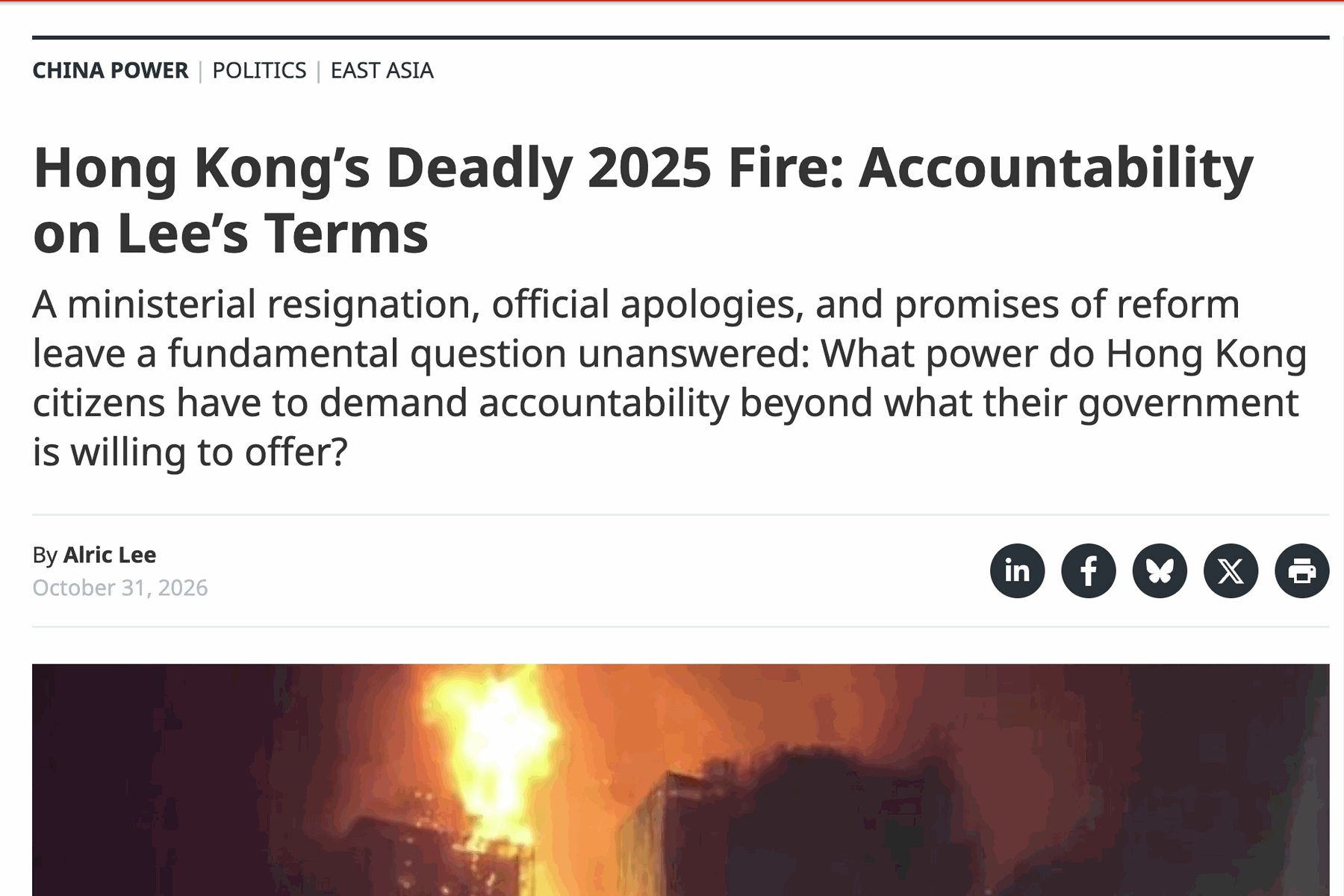
Flames engulf Wang Fuk Court, Tai Po, 26 November 2025. Screenshot / China News Service (中国新闻社).
Hong Kong's Deadly 2025 Fire: Accountability on Lee's Terms
- Published in
- The Diplomat
- Date
- 31 October 2026
A ministerial resignation, official apologies, and promises of reform leave a fundamental question unanswered: what power do Hong Kong citizens have to demand accountability beyond what their government is willing to offer?
This commentary, published in The Diplomat's China Power section, examines the government's response to the Wang Fuk Court fire that killed 168 people in November 2025.
Accountability "to nanometre precision." When Chief Executive John Lee announced the resignation of Housing Secretary Winnie Ho, a bereaved family member — Yip Ka-kui, who lost his wife — asked why only one minister had been made to bear political responsibility, describing the approach as accountability calculated with nanometre precision. The independent committee had found pervasive failures across the Housing Bureau's Independent Checking Unit and the Buildings, Fire Services and Labour departments; yet Lee offered no consistent, publicly examinable standard for why one bureau's minister resigned while others did not.
On the executive's terms. The remaining ministers made the logic explicit — one likened the Chief Executive to a ship's captain whose crew must follow instructions; another said appointed officials must answer to him and would remain in office as instructed. Ho left because Lee decided she should; the others stayed because he decided they should. The committee itself was appointed by Lee, non-statutory and without compulsory evidence-gathering powers, and reported back to the same executive that determines what its findings mean. Accountability becomes something the government delivers and declares complete.
Citizens with little leverage. Under current arrangements, the Chief Executive is chosen by a 1,500-member Election Committee and only 20 of the Legislative Council's 90 seats are directly elected, with candidates screened — so citizens have limited electoral means to impose consequences. Public pressure is constrained too: a student, Miles Kwan, was detained after distributing material demanding an independent investigation. Beijing's Liaison Office recast a report on pervasive government failures as proof of "responsible governance," and a property-acquisition scheme pressed residents to sell their Wang Fuk Court titles on deadlines that fell before the committee's findings were even published. The imbalance, the commentary concludes, is that those who suffered the failures have little authority to demand a different outcome — and no amount of official contrition or administrative reform resolves it.