離、散、光、復 (Depart, Scatter, Light, Restore)
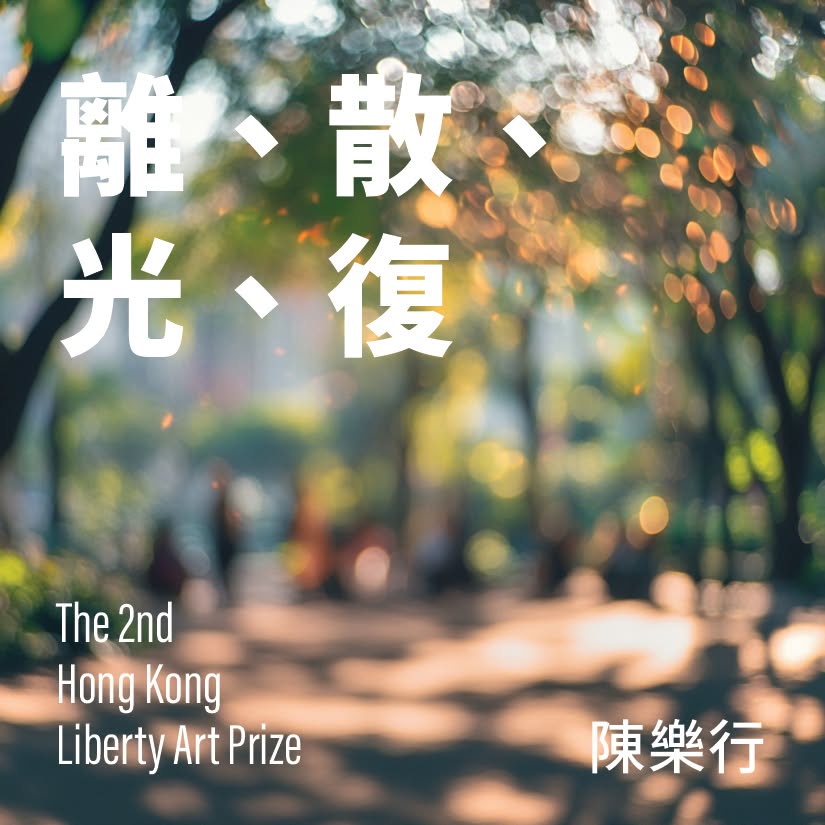
- Artist
- 陳樂行
- Artwork Title
- 離、散、光、復 (Depart, Scatter, Light, Restore)
- Medium
- Poetry
- Creation Year
- 2024
Description
A recently published Hong Kong government–funded literary study claimed that "Cantonese / Hong Kong vernacular cannot write poetry, and therefore cannot be classified as a literary category." The author takes the occasion of the Liberty Art Prize to challenge this claim with a concrete example—using the competition's themes of "diaspora" and "restoration" as his subject, writing an experimental poem that tests whether the unique rhythmic and phonetic qualities of Cantonese can penetrate other Hongkongers' minds more deeply. The poem draws on the author's personal experience and imagination, exploring the four characters 離 (depart), 散 (scatter), 光 (light), 復 (restore) through literary technique and artistic imagination uniquely suited to Cantonese.
Original Work (原文)
離、散、光、復
月球離地三十八萬公里
仲係肉眼可見嘅距離
離香港七千公里
返去使唔使等半個世紀
物理冇所謂拋唔拋棄
作用力等於反作用力嘅定理
呢一刻我地變咗人地
四十年就寫多篇出埃及記
一個人有乜嘢咁可悲
要獨立先試下獨立自己
一隻隻棋喺宇宙分散
一粒粒沙計算緊時間
一條條路係自己去揀
留一口氣 燈可以點多一盞
可以打散 唔可以打爛
有人走難 有人走盞
有人想慳 有人想揀
最後最後 所有嘢都會埋單
每個人都掛住一個啷啷
二十年代開始被強制安裝
思考多少少都會當做骯髒
唔好亂諗嘢但求身體安康
每個城市都有幾條暗巷
總有一啲角落冇人可以mon
可以搵到呼吸嘅地方
潘朵拉盒底都仲有啲希望
唔知密碼不如試下逐個撞
當混沌變做social norm
粒子對撞可以撞出光
水泥森林嘅混濁
霧霾遍佈嘅大陸
編號不明嘅制服
以毒攻毒
拒絕麻木
口服唔等同心服
孤獨嘅追逐
陸續被閱讀
種子會成熟
藤蔓穿破僵局
歷史嘅眼目
某一個星期六
埋伏
覺醒嘅民族
月球再次登陸
Judge's Comment
This is an excellent attempt at poetry writing in Cantonese. In each of the poem's four stanzas, every line fully rhymes—the rhyme vowels are drawn respectively from the four characters 離, 散, 光, 復. The effort required to achieve this is clear. In terms of imagery, there is coherence between opening and close, both using "the moon." At the same time, however, the rhyming renders the poem somewhat over-regular, which paradoxically weakens its musicality when read aloud—the result of each stanza's sole rhyme vowel being repeated ten to fifteen times, leaving the regularity without sufficient flexibility. The classical principle that "the first, third, and fifth positions are flexible; the second, fourth, and sixth are fixed" was itself a pursuit of balance between regularity and freedom. Furthermore, unless one deliberately writes obscure verse in the manner of Li Shangyin—inviting the reader to open their imagination without limit—two things must be attended to: the theme and the imagery used to illuminate it. In poetry, especially short poetry, clarity of theme is paramount; imagery should not be excessive, as too much disperses focus on the theme and makes it difficult for readers to absorb. Typically one image per stanza is sufficient; the remaining lines circle that image with precision, giving it depth and dimension. Setting an abstract theme for each of the four stanzas is of course permissible, but five or six images per stanza seems excessive. On these points, one may consult Chapter 48 of Dream of the Red Chamber, where Daiyu teaches Xiangling to write poetry: "Form is ultimately secondary; what matters first is the intent. If the meaning is true, even unpolished words will be fine—this is called 'not letting words harm meaning.'" The "intent" referred to here means establishing the theme. To summarize, I offer as a model of fine poetry in Cantonese the song "Wu Mei Niang" (舞媚娘)... [with examples of classical Cantonese rhyming]. For those who wish to seriously develop poetry written in Cantonese, in addition to learning from the finest Cantonese popular songs, one can also draw nourishment from classical verse; it is also worth consulting vernacular poetry written by May Fourth writers, especially Hu Shi.
— Lian Yi-zheng (練乙錚)